

Arcserve
June 10, 2019
2 min read
For many SMBs, it’s practical to use a private cloud for everything from software as a service to storage infrastructure and more. With benefits like cost savings, live support, and more, it’s tempting for enterprises to also ditch their hybrid cloud infrastructure in favor of public cloud offerings. But before you jump ship altogether, there are still plenty of compelling reasons to stick with a hybrid cloud infrastructure. Let’s take a look.
 You know the importance of backup and disaster recovery, but have you considered the challenges associated with trusting all your data to a public cloud? Big providers can
suffer from downtime like any other business, which can cost an enterprise as much as
$5600 a minute! For disaster recovery and business continuity, it’s wise to ensure that none of your data is ever in one place. To ensure redundancy, a hybrid cloud model makes it easy to back up local data to the cloud, back up cloud data locally, or even back up
cloud data to a secondary cloud. Flexible recovery options like these mean that when something goes wrong (something
will go wrong), you have numerous ways to get your systems online.
You know the importance of backup and disaster recovery, but have you considered the challenges associated with trusting all your data to a public cloud? Big providers can
suffer from downtime like any other business, which can cost an enterprise as much as
$5600 a minute! For disaster recovery and business continuity, it’s wise to ensure that none of your data is ever in one place. To ensure redundancy, a hybrid cloud model makes it easy to back up local data to the cloud, back up cloud data locally, or even back up
cloud data to a secondary cloud. Flexible recovery options like these mean that when something goes wrong (something
will go wrong), you have numerous ways to get your systems online.
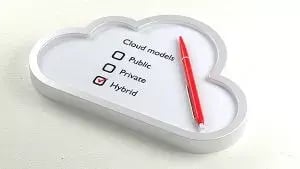 While many public cloud offerings can help an enterprise scale, they often do so at lofty expense. Depending on a company’s size, infrastructure needs, and approach, a private cloud can pay for itself over time. After initial up-front investment, and minimal costs for maintenance and upgrades, and enterprise gets a system they own, which can help lower operational expenses. With a public cloud, however, monthly fees and annual subscriptions only rise when you scale up and costs become exorbitant the more you entangle yourself with cloud vendors.
Adaptability and Control
Enterprises must be agile to capitalize on changing markets and new opportunities, and they must be positioned to grow quickly as they do. A hybrid cloud model (particularly those leveraging hyper-converged infrastructure technology) allow admins to quickly scale operations up or down, maintain full control of their networks, and offers full flexibility in terms of the hardware and software that powers their business. The hybrid cloud model also lets enterprises thoughtfully leverage the public cloud solutions they do need, without sacrificing control over things that matter the most like data security, firewalls, anti-virus, and so on. For many enterprises, the ability to customize their operations from top to bottom is plenty enough reason to keep their hybrid model.Disaster Recovery and Business Continuity
Security
You’ve seen enough articles about data breach to know that there’s no such thing as “too big to fail.” Even the largest companies suffer data breach, so it’s wise to ask yourself: is my sensitive data safe with a cloud provider? Taking security into your own hands helps you ensure that your data is safely protected behind your firewalls, policies, and company protocols for data protection. With a public cloud, do you really know where your data is? Is it as safe as they claim? Any business with sensitive data should consider whether any of it should be in the hands of a third party alone.Lower Total Cost of Ownership
Simple Management and Self-Reliance
Ensuring that disparate cloud solutions all play nice can be tough. Rather than worry about which cloud providers integrate with which others, a hybrid cloud model lets you decide what to build in-house and what you can rely on third parties for. Rather than having a massive vendor list, you have an elite team managing and troubleshooting the infrastructure you defined. This means your team gains intimate knowledge of makes your business tick, what will remedy problems, and what steps will help the business grow and scale effectively.Conclusion
Third parties can help with your infrastructure, but why lean on them completely when a hybrid model offers the best of public and private clouds? While there are certainly benefits to moving to a public cloud model, there are few reasons for an enterprise to ditch their private clouds altogether—particularly when they’ve already invested in their internal systems. Instead, smart enterprises should stick with the option that gives them the most flexibility and control and use the private cloud to help out as needed.Don't forget to share this post!
