

Ransomware statistics from the 2026 State of Data Resilience market study point to one gap above the rest: confidence outruns proof.
The ransomware statistics below come from more than 200 IT professionals surveyed worldwide in Q1 of 2026. The audience included a split of Arcserve current customers and those who do not use Arcserve data resilience solutions.
About 65% said their organization could recover from a ransomware attack within 48 hours. Only 35% had met their recovery targets in a real test.
That gap frames the ransomware trends for 2026. The increase in ransomware attacks continues, defenses stay partial, and recovery often goes untested until an attack forces the question. The sections below pair the survey findings with third-party ransomware stats from 2026 to show where the numbers line up.
Ransomware Statistics at a Glance
These six ransomware facts summarize the survey findings before the detail below.
-
52.3% of surveyed IT professionals have faced a ransomware event; 25.1% of that group within the past 12 months.
-
65.1% feel confident in sub-48-hour ransomware recovery, but 35.4% met recovery targets in testing.
-
24.1% have not tested full data recovery.
-
49.2% have deployed immutable backup storage, the control that keeps attackers from deleting recovery points.
-
57.9% rank AI anomaly detection as the highest-value recovery use case, yet 17.4% have deployed it.
-
88.7% run two or more data protection tools, adding recovery complexity.
How Common Is Ransomware? Attack Statistics Point to a Current Problem
The largest ransomware attacks draw the headlines, but the everyday ransomware attack statistics matter more. More than half of surveyed IT professionals have faced a ransomware event, so the risk is active rather than hypothetical.
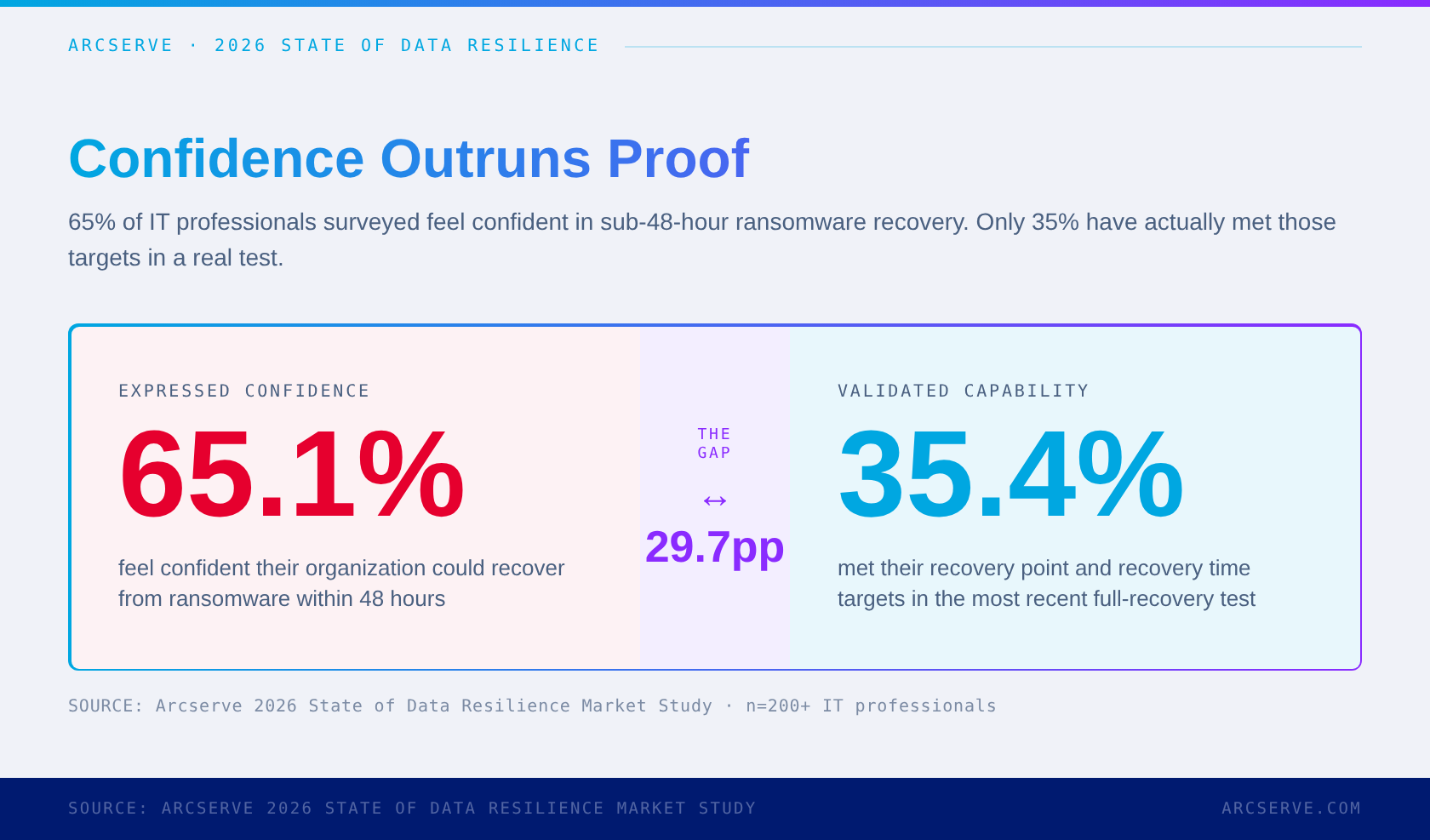
In the survey, 52.3% reported a ransomware event at some point, and 25.1% of that group encountered one within the past 12 months. Ransomware ranked as the top data resilience concern, cited by 59.0% of IT leaders ahead of budget and compliance.
Ransomware Statistics by Year
Ransomware statistics by year confirm the pattern. The 2026 Data Breach Investigations Report found ransomware present in 48% of breaches, up from 44% the prior year.1 That four-point ransomware YoY increase comes from analysis of more than 31,000 security incidents across 145 countries.1
Small business ransomware statistics run higher still. Ransomware appeared in 88% of breaches at small and mid-size businesses, against 39% at large enterprises.1 Tracked victim counts moved the same direction, with 7,551 publicly disclosed ransomware victims between April 2025 and March 2026, a 24.9% increase over the prior period.2
Attack methods shifted in 2026. A vendor-agnostic survey of 2,158 IT and security leaders across 17 countries found malicious email (26%) and phishing (24%) displaced exploited vulnerabilities as the top technical root cause.3 Exploited vulnerabilities fell 14 percentage points to 18%, ending a three-year run at the top of that list.3
Confidence Outruns Tested Ransomware Recovery
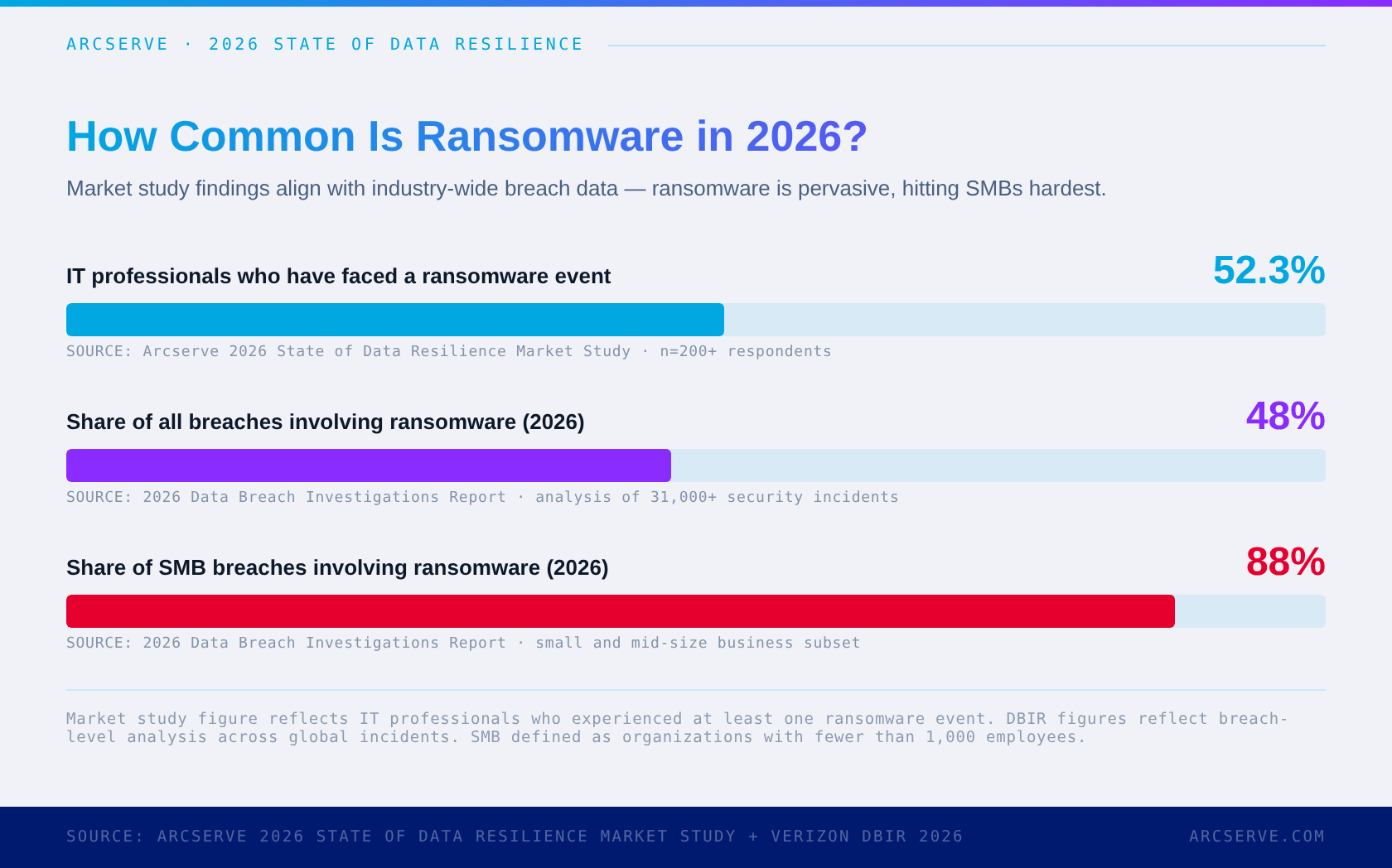
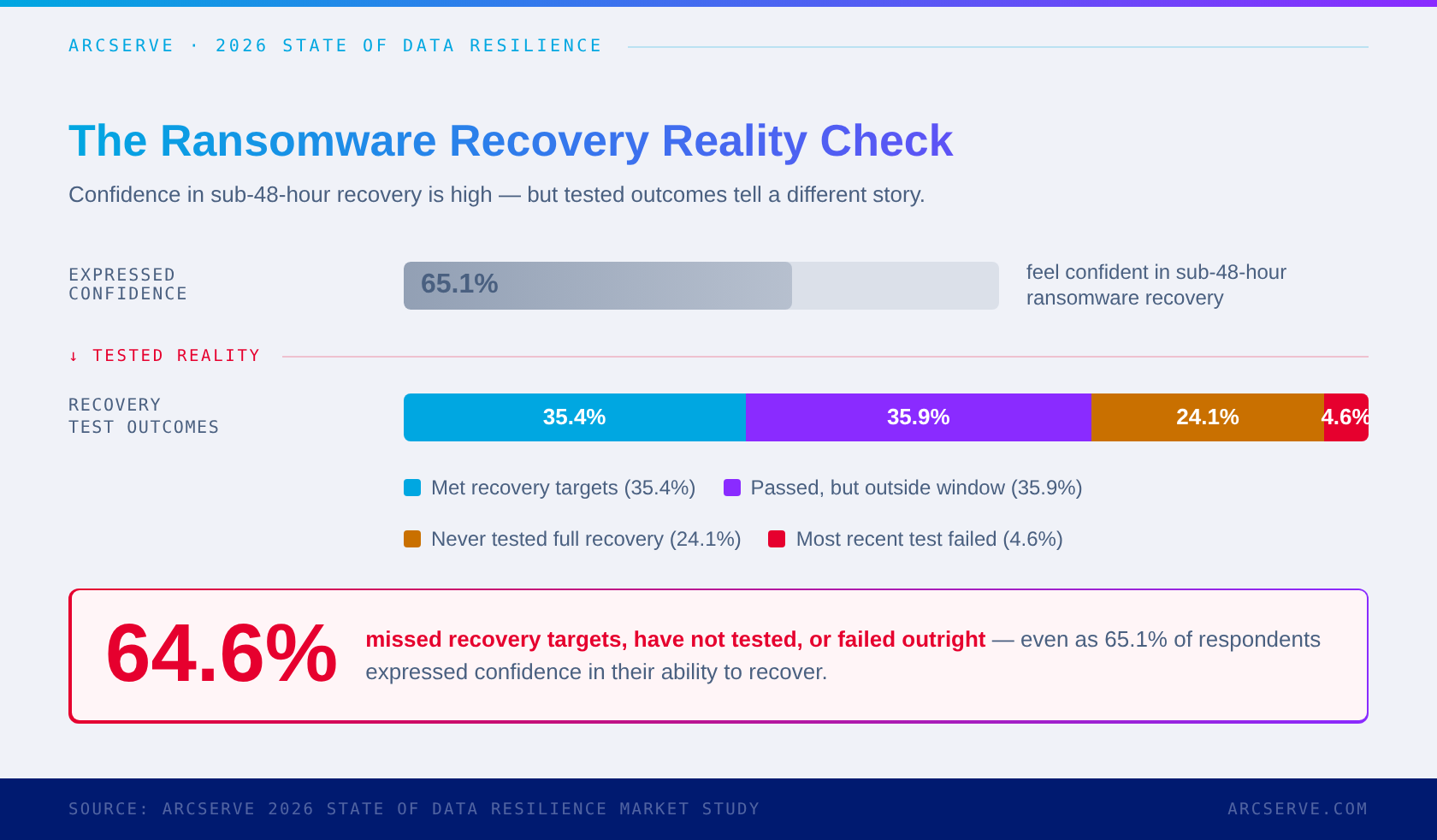
The widest gap in the ransomware attack statistics sits between recovery confidence and recovery proof. In the survey, 65.1% expressed confidence in recovering within 48 hours, but the ransomware stats on testing tell a different story.
-
35.4% met their recovery point and recovery time targets in the most recent full-recovery test.
-
35.9% passed the test, but outside the target window.
-
24.1% have not tested full recovery, and 4.6% saw their most recent test fail.
Combined, 64.6% of organizations missed their targets, have not tested, or failed outright, despite the 65.1% who felt confident.
Independent 2026 research found the same disconnect. A survey of 301 IT decision-makers across six countries reported 94% confidence that disaster recovery plans covered current operating scenarios, while only 32% tested those plans monthly.4 Confidence tracks the presence of plans and tools rather than the frequency of testing under realistic conditions.
Practitioners described the gap in their own words in the survey. One cited "backups exist, but restores fail or take too long." Another pointed to "the disconnect between what we think we can recover and what we can actually recover."
64.6% of organizations missed recovery targets, have not tested, or failed a test, even as 65.1% expressed confidence in recovery
Ransomware Statistics Show an Immutability Gap in Recovery
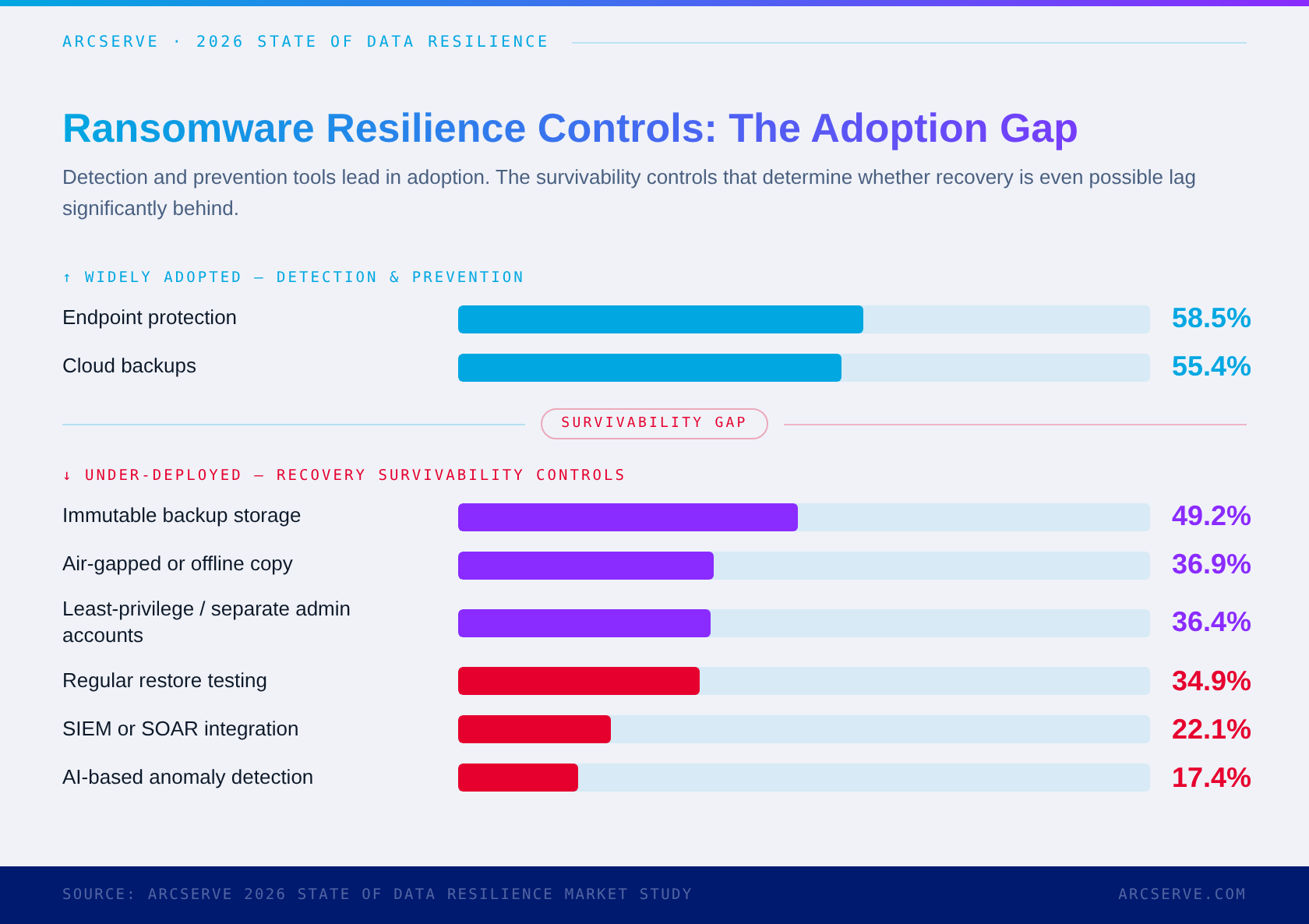
Immutable backup storage keeps attackers from deleting or encrypting recovery points, yet fewer than half of surveyed organizations have deployed it. Immutable storage sat at 49.2% adoption, while 52.3% had already faced ransomware. Regular restore testing was lower still, at 34.9%.
Familiar ransomware prevention software shows higher adoption than the survivability controls that decide whether recovery works. Endpoint protection and cloud backups lead the list, while immutable storage, restore testing, and AI anomaly detection trail behind.
| Ransomware Resilience Control | Deployed |
|
Endpoint protection |
58.5% |
|
Cloud backups |
55.4% |
|
Immutable backup storage |
49.2% |
|
Air-gapped or offline copy (excl. tape) |
36.9% |
|
Least-privilege or separate admin accounts |
36.4% |
|
Regular restore testing |
34.9% |
|
SIEM or SOAR integration |
22.1% |
|
AI-based anomaly detection |
17.4% |
Third-party ransomware stats show what recoverable backups are worth. Backup-based recovery reached 66% of encrypted-data cases in 2026, a 12-point increase year over year.3 Even with that improvement, 48% of encrypted victims still paid a ransom, and 56% of attacks succeeded in encrypting data, up from 50% the prior year.3
The average cost of a ransomware attack continues to climb. Average recovery cost reached $1.7 million per incident in 2026, an 11% year-over-year increase.3 Cyber insurance carriers now list immutable or offline backups, tested regularly, among baseline requirements before binding a policy.
Most Ransomware Recovery Plans Go Untested
The facts about ransomware recovery testing are blunt, because a quarter of surveyed organizations have not tested full recovery. That 24.1% cohort carries the highest risk, since its recovery targets are assumptions rather than validated capabilities. Together with those who missed targets or failed, 64.6% have not shown that recovery works under realistic conditions.
Wider ransomware trends show the same testing gap. Only 32% of IT decision-makers surveyed in 2026 test disaster recovery plans monthly, against 94% who report confidence in recovery coverage.4
Organization size changes the outcome. Only 34% of small organizations with 100 to 250 employees stopped attacks before encryption, against 46% at organizations with 3,001 to 5,000 employees.3 Untested recovery turns a ransomware event into an open question at the worst possible moment.
24.1% of organizations have not tested full data recovery, leaving recovery targets unproven
AI Shifts from Ambition to Early Ransomware Detection
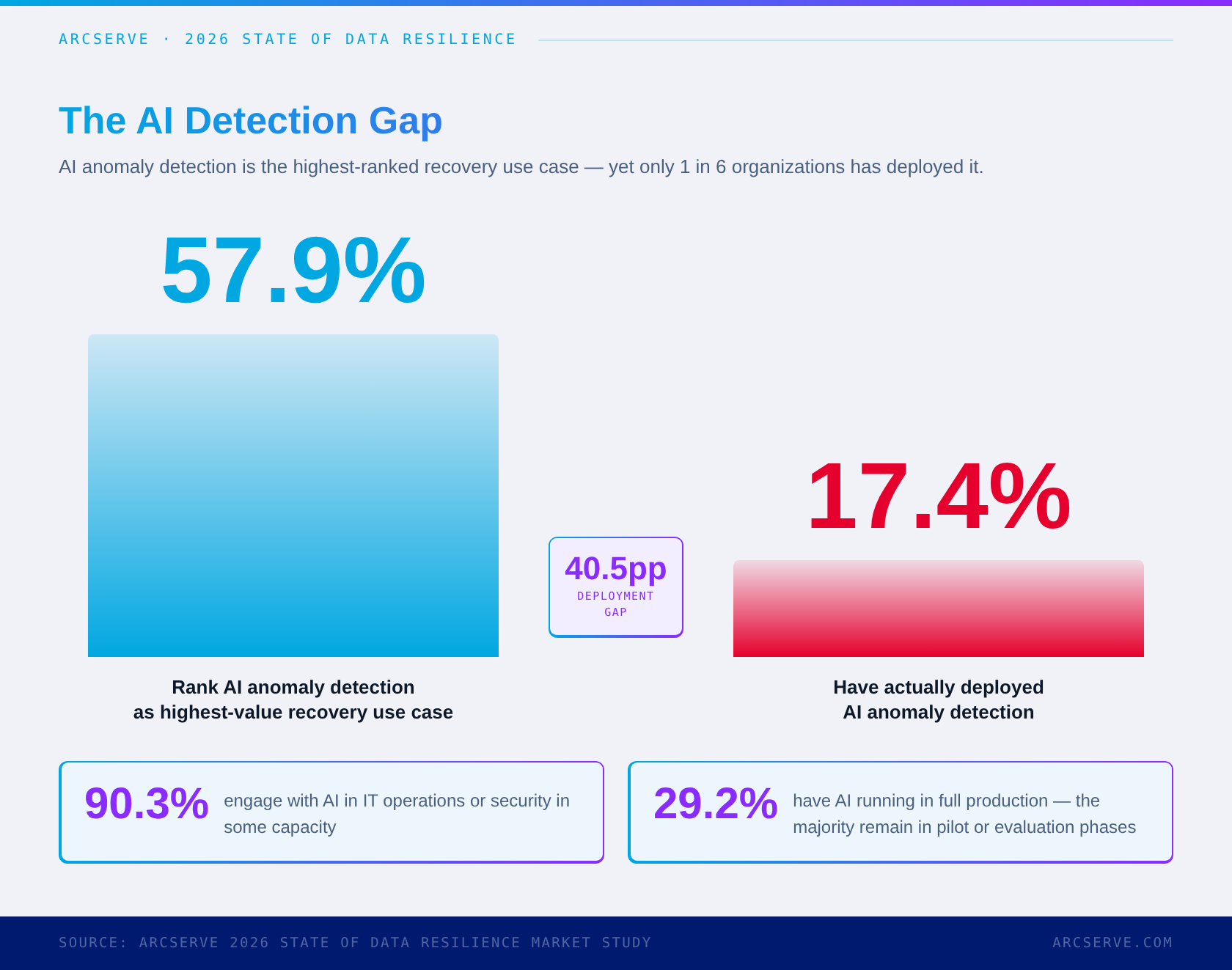
Early ransomware detection is the AI use case IT professionals value most, but deployment lags far behind interest. In the survey, 57.9% ranked detecting abnormal data changes and encryption behavior as the highest-value AI application for backup and recovery. Only 17.4% have deployed it.
The appetite is there. About 90.3% of respondents engage with AI in IT operations or security, though 29.2% have it running in production workflows. The chance sits in directing that interest toward detection and early warning in backup environments.
Third-party ransomware trends reinforce the urgency. A 2026 report on AI-era ransomware found 65% of victims said AI made the attack more effective.5 Identity-based approaches now start 79% of ransomware attacks, which compresses the window between initial access and encryption.3 Early warning inside backup environments is where AI anomaly detection produces measurable value.
57.9% vs. 17.4% rank AI anomaly detection as the highest-value recovery use case versus the share that has deployed it
Ransomware Payouts, Economics, and the Insurance Lever
Cyber insurance now shapes ransomware controls as much as budget does. In the survey, 22.6% hold insurance that significantly shapes their controls and testing, and 20.5% let insurance evaluation drive planned changes. Another 36.9% carry no cyber insurance and set controls on internal criteria.
Compliance adds a second push. Compliance ranked as a top concern for 34.9% of respondents, yet 52.9% of that group have not deployed immutable backup storage. Immutable storage answers both the ransomware and the compliance requirement in one deployment.
Insurance and payout data from 2026 shows why controls now come before coverage. A 2026 cyber claims report found 86% of businesses refused ransomware payouts, a record high.6 Median ransom demands fell to $698,000, down 65% over two years, and 51% of paying organizations negotiated below the original demand.3
The market behind those policies keeps expanding. Global cyber insurance premiums reached roughly $16.3 billion in 2026, a 7% increase over the prior year, with projections near $28 billion by 2030.7 Carriers increasingly require multi-factor authentication, endpoint detection, and immutable tested backups before writing a policy.
|
Cyber Insurance Posture |
Share of Respondents |
|
Hold insurance; significantly influences controls and testing |
22.6% |
|
Hold insurance; minimal influence on decisions |
20.0% |
|
Evaluating insurance; requirements driving changes |
20.5% |
|
No insurance; not currently a priority |
18.5% |
|
No insurance; near-term priority |
18.5% |
Tool Sprawl Raises Ransomware Recovery Risk
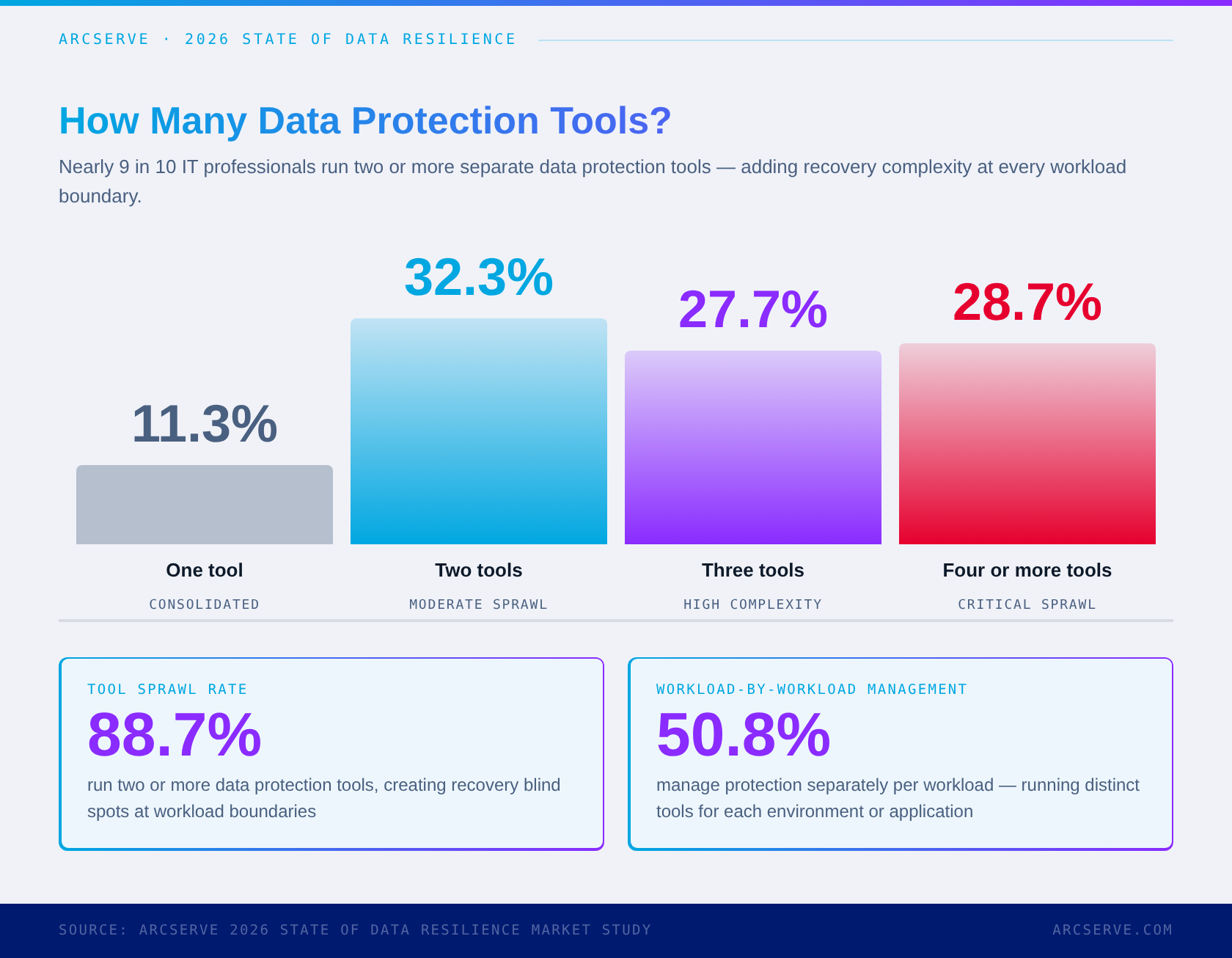
Fragmented toolsets widen the gaps attackers exploit during recovery. The ransomware stats on tooling are telling: only 11.3% of surveyed organizations use a single data protection product. The largest group runs two tools at 32.3%, followed by three at 27.7%, while 28.7% operate four or more.
Half of respondents, 50.8%, manage protection workload by workload, running separate ransomware prevention software and backup tools for virtual machines, SaaS applications, and endpoints. That pattern leaves policy consistency to manual coordination, which creates protection gaps at each workload boundary. During a ransomware event, gaps discovered at recovery time cannot be closed retroactively.
Identity and SaaS Data Are Ransomware Targets
Identity systems and SaaS data are prime ransomware and account-takeover targets, yet coverage stays thin. The SaaS ransomware stats bear that out: Microsoft 365 backup is the most common at 63.1%, while Microsoft Entra ID, a frequent account-takeover target, is protected by 36.9%. Almost one in five organizations, 19.0%, have no SaaS backup in place.
The exposure is growing. Identity-based approaches started 79% of ransomware attacks in 2026, and 67% of victims confirmed that the ransomware incident and their most significant identity attack were the same event.3
Coverage gaps explain much of that exposure. Among victims compromised through credentials, 97% had multi-factor authentication enabled in some form, with the gaps concentrated outside SaaS accounts in VPNs, firewall consoles, and legacy applications.3
The shared responsibility model adds to the gap. SaaS providers protect service availability, but they do not back up customer data against ransomware, insider threats, or account compromise.
What the Ransomware Data Means for 2026 and 2027
These ransomware statistics point to five priorities that carry direct weight for budget and strategy planning.
-
Test recovery before relying on it. 64.6% have not shown that recovery works under realistic conditions, so testing against defined targets is the first step.
-
Close the immutability gap. 52.3% have faced ransomware while 49.2% have deployed immutable storage, the control that preserves recovery options.
-
Direct AI toward early detection. 57.9% value AI anomaly detection most, 17.4% have deployed it, and 90.3% engage with AI in some form.
-
Align controls with insurance and compliance. Insurance and compliance requirements for immutability, multi-factor authentication, and restore testing mirror the gaps this survey identifies.
-
Consolidate fragmented tools. 88.7% run two or more tools; reducing sprawl removes recovery blind spots at workload boundaries.
Methodology and How to Cite These Ransomware Statistics
The 2026 State of Data Resilience market study reached more than 200 IT professionals and leaders worldwide in early 2026, across 30 questions in single-select, multi-select, Likert-scale, and open-ended formats. Percentages come from the survey dataset, and multi-select totals can exceed 100%. Results represent this respondent population and are not statistically representative of the wider IT profession. These ransomware statistics and charts may be used with attribution to Arcserve and a link back to this page.
Third-party figures, including the ransomware statistics by year cited above, are drawn from 2026 sources and listed in the footnotes below.
Strengthen Ransomware Recovery with Arcserve
Arcserve, the pioneer in unified data resilience, protects data from ransomware, cyberattacks, and disasters with data protection solutions for small and mid-size organizations. The ransomware facts above point to a clear direction: closing the gap between perceived readiness and tested recovery calls for ransomware prevention software paired with immutable storage, validated recovery workflows, and unified protection across physical, virtual, cloud, and SaaS environments.
Learn more about Arcserve Ransomware Protection and Recovery Suites - ransomware recovery solutions packaged for lean IT teams, which combine the technology, procedures, and expert assistance that small and midsize organizations need to protect backup data and restore operations after a ransomware attack.
External Sources
1. 2026 Data Breach Investigations Report. Analysis of more than 31,000 security incidents across 145 countries. Published May 2026.
2. 2026 Ransomware Report. Tracking of 7,551 publicly disclosed ransomware victims, April 2025 through March 2026.
3. The State of Ransomware 2026. Vendor-agnostic survey of 2,158 IT and cybersecurity leaders across 17 countries whose organizations experienced a ransomware attack in the previous 12 months.
4. Peer insights on AI adoption and the disaster recovery gap, 2026. Survey of 301 IT decision-makers across Australia, France, Germany, New Zealand, the United Kingdom, and the United States, conducted by Foundry (an IDG company).
5. 2026 AI-Era Ransomware report.
6. 2026 Cyber Claims Report.
7. Global cyber insurance market analysis, 2026.
Don't forget to share this post!
