

Arcserve
November 05, 2020
2 min read
Just about every business is seeing the amount of data they need to move, store, and back up is growing by leaps and bounds. A recent update to the Global Datasphere Forecast from IDC says
more than 59 zettabytes (ZB) of data will be created, captured, copied, and consumed globally in 2020. But that’s just the tip of the iceberg. IDC goes on to say that
the amount of data created over the next three years will be more than all of the data created over the past 30 years. Without a doubt, your company will experience these statistical changes firsthand. That means you’ll need to add more and more storage, and that comes with a cost. The question is, will your existing storage solution be able to easily scale to meet these demands? Will you still be able to manage your data efficiently? And can you do all of that without blowing your budget? Most legacy solutions lead to costly forklift upgrades at some point. So let’s compare traditional storage to scale-out storage solutions.
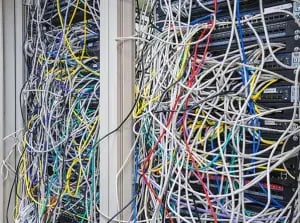 Most legacy storage solutions are built to scale-up. This approach usually includes one or two controllers and multiple shelves of drives. Adding more storage requires adding another shelf of drives, but this type of architecture can only expand within the limits of the storage controllers. Once that limit is reached, the only option is to add a new system in addition to the existing system. You can see where this takes you over time. Each time you add a new system you add complexity, opening the door for less efficient allocation of resources and, typically, more time spent managing your data. Ultimately, you’ll reach the point where a forklift upgrade is the only way out, and that
can break your budget.
Most legacy storage solutions are built to scale-up. This approach usually includes one or two controllers and multiple shelves of drives. Adding more storage requires adding another shelf of drives, but this type of architecture can only expand within the limits of the storage controllers. Once that limit is reached, the only option is to add a new system in addition to the existing system. You can see where this takes you over time. Each time you add a new system you add complexity, opening the door for less efficient allocation of resources and, typically, more time spent managing your data. Ultimately, you’ll reach the point where a forklift upgrade is the only way out, and that
can break your budget.
Traditional Storage Solutions Have Limits
Scale-Out Storage: Simple, Future-Proof
Scale-out storage is network-attached storage (NAS) where the amount of disk space can be expanded by adding more nodes to individual storage clusters, and where you can add more clusters as you need them. As the amount of data you handle increases, scale-out solutions like StorageCraft OneXafe® make it easy to add nodes and drives to your cluster in minutes, with zero configuration. That alone is a critical advantage over scale-up solutions. Instead of a time-consuming and complex installation, adding more storage is a snap. The added advantage from StorageCraft’s scale-out storage solutions is your ability to future-proof against ever-increasing amounts of data by making it easy to add more storage anytime, only when you need it. That makes increasing your storage capacity seamless, simple, and efficient.Scale-Out For Multiple Use Cases
While all of StorageCraft’s scale-out solutions are built on a unified architecture with enterprise-grade features, your specific requirements likely go beyond architecture. That’s why StorageCraft offers cost-effective all-flash scale-out storage for high-performance applications and virtual environments and scale-out capacity storage for unstructured data and backup targets. Even better, StorageCraft scale-out storage solutions feature simple, powerful administration that lets you manage your storage from wherever you are while eliminating unnecessary configuration. StorageCraft solutions also protect and optimize your data, with inline deduplication, compression, continuous snapshots, and data encryption.Learn More
If you’re looking at solving your storage equation and seeing dark clouds, it’s time to take a closer look at switching to scale-out storage. Schedule a demo with a StorageCraft engineer to clear away the clouds, and understand your options and all of the benefits of scale-out storage.Don't forget to share this post!
