Ransomware Targets Your Backups First
Modern ransomware campaigns don't stop at encrypting production data. Attackers harvest credentials, gain administrative access to backup repositories, and delete recovery points before launching the encryption attack. All to ensure paying the ransom feels like the only option. Recovery costs can reach 10x the ransom amount if there are no clean backups for data recovery.
Immutable Storage—Protection That Survives Credential Compromise
Immutable storage implements Write-Once-Read-Many (WORM) semantics at the file system level. This means once data is written, it cannot be altered, encrypted, or deleted for a defined retention period—even by users with root access.
This creates a tamper-proof backup state that survives ransomware encryption attempts, administrative deletion commands, and insider threats. Even when attackers compromise backup administrator's credentials, immutable backup snapshots remain intact and accessible for recovery.
Why Read This White Paper
Given the growing threat landscape, this white paper will help you:
- Learn what “true immutability” means (WORM semantics) and why it must survive encryption attempts, deletion commands, and time manipulation attacks
- See how OpenZFS stops ransomware at the storage layer with copy-on-write snapshots, end-to-end checksums, and ZFS holds that prevent snapshot deletion—even by privileged users
- Understand the controls that make immutability practical in real environments
- Map storage security to the NIST CSF 2.0 framework with a clear breakdown of how immutable storage supports Govern, Identify, Protect, Detect, Respond, and Recover guidelines
- Get deployment and operational guidance to use immediately, including snapshot schedules, capacity planning, monitoring thresholds, and ransomware simulation/testing steps
- Support compliance requirements with confidence (SEC 17a‑4(f), HIPAA, GDPR, SOX) through retention locks, audit trails, and rapid retrieval
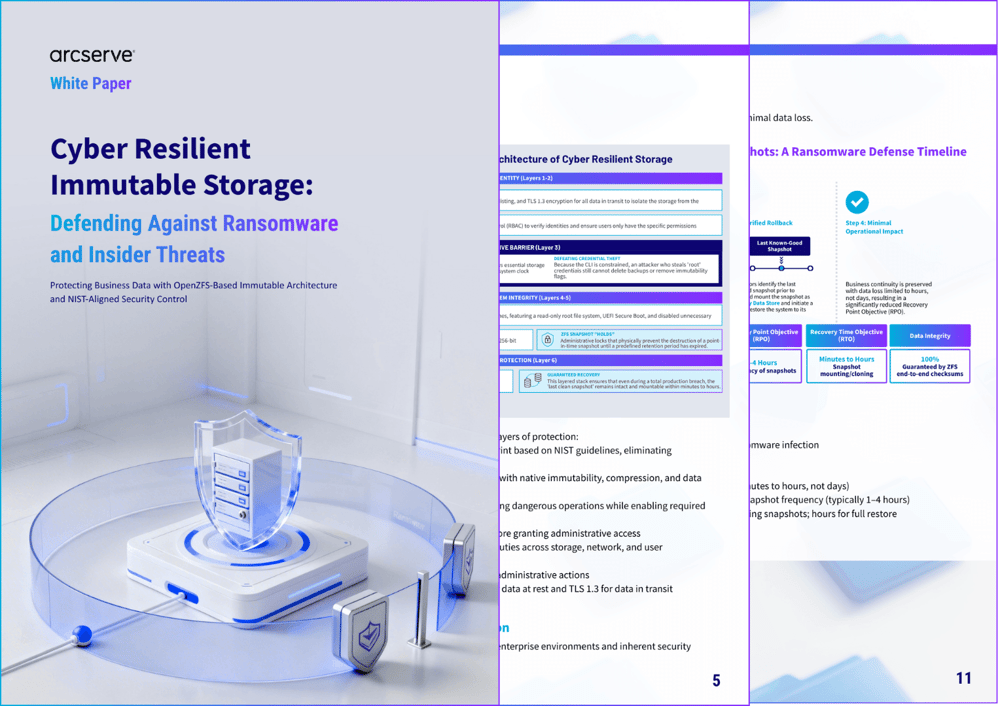
Cyber Resilient Immutable Storage
Defending Against Ransomware and Insider Threats
Why Arcserve Cyber Resilient Storage
Arcserve Cyber Resilient Storage delivers air-gap equivalent protection without the operational complexity of traditional air-gapped systems.
Built on OpenZFS with a 15-year track record in enterprise environments, the solution provides:
- File system-level immutability that survives root-level compromise
- Recovery in minutes to hours instead of days to weeks
- Continuous accessibility with full automation support
- Compliance with SEC, FINRA, HIPAA, GDPR, and SOX requirements
- Predictable capacity planning with 2:1 compression ratios and 5–20% snapshot overhead (when used with Arcserve UDP compression and deduplication)
Frequently Asked Questions
How Is Immutable Storage Different from Traditional Backup Approaches?
Traditional backups rely on access controls and perimeter defenses. When attackers gain administrative credentials through phishing, credential theft, or insider access, they can delete or encrypt backup data. Immutable storage with OpenZFS creates snapshots protected by ZFS holds that prevent modification or deletion during retention periods—even with root access. The constrained administrative interface blocks dangerous operations while allowing necessary management tasks.
What Makes OpenZFS-Based Immutability Superior to Other Approaches?
OpenZFS uses copy-on-write architecture where original data blocks are never overwritten. Modifications create new blocks; original blocks remain intact. Combined with ZFS holds that prevent snapshot deletion and retention policies that enforce minimum hold periods; this creates true immutability at the filesystem level. OS-level file flags require root to set and root can remove them. Object storage locks require S3-compatible infrastructure. Hardware WORM is expensive, slow to recover, and requires manual processes. OpenZFS delivers immutability natively with fast random access and full automation.
How Does Cyber Resilient Storage Defend Against Insider Threats?
The constrained administrative interface of Cyber Resilient Storage limits available commands to essential operations only. Even privileged users cannot delete snapshots during retention periods, disable immutability flags, gain shell access to the underlying OS, manipulate system clocks, or disable audit logging. Disgruntled administrators attempting backup deletion before leaving, compromised credentials used by external attackers, and accidental deletion during troubleshooting all fail against these controls. Role-based access control enforces separation of duties across storage, network, and user management functions.
What Compliance Requirements Does Immutable Storage Address?
Immutable storage provides non-rewritable format, tamper-proof retention, audit trails, data integrity verification, and immediate retrieval capability required by many regulations, including SEC Rule 17a-4(f) requiring WORM storage for financial records, FINRA Rule 4511(c) requiring tamper-proof electronic records, HIPAA Security Rule requiring administrative, physical, and technical safeguards for ePHI, GDPR Article 32 requiring appropriate security measures for data processing, and SOX Section 404 requiring internal controls over financial reporting.
Cyber Resilient Immutable Storage: Technical White Paper
Protecting data with OpenZFS-based immutable architecture and NIST-aligned security controls