
Benchmark Data Resilience in 2026
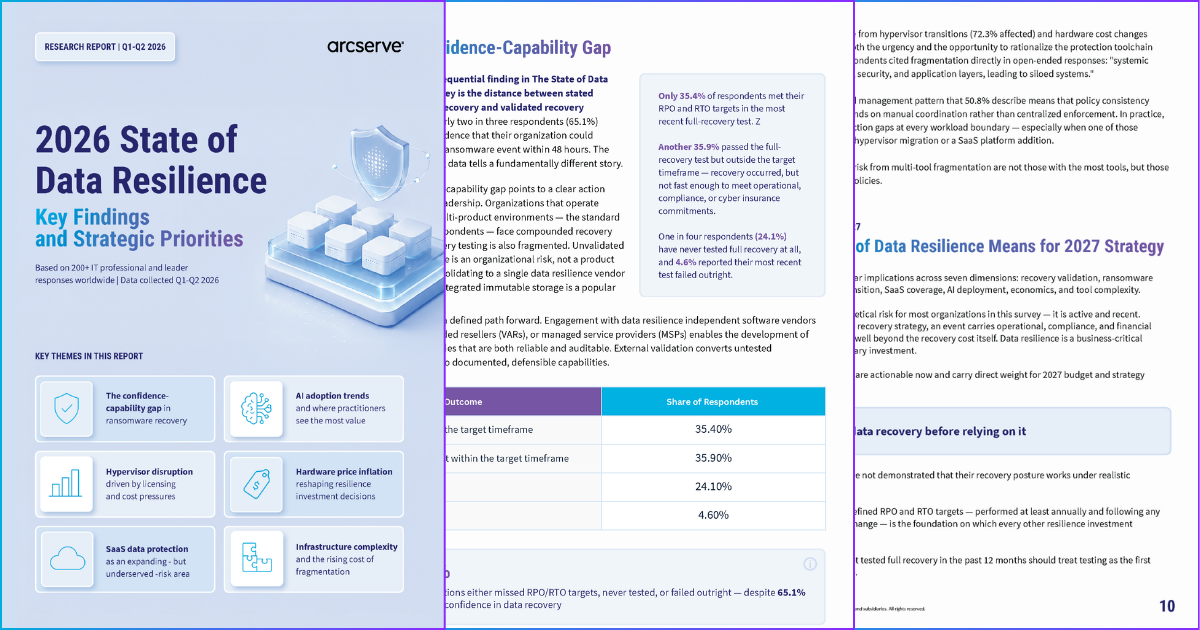
See where IT organizations stand on ransomware recovery, AI adoption, infrastructure change, SaaS backup coverage, and tool complexity. Based on responses from more than 200 IT professionals and leaders worldwide, the findings reveal where confidence is outpacing validated recovery capability. Many respondents were not Arcserve customers, making this a true market study.
Why Read This Report
Learn where data resilience gaps are widening, which priorities are shaping 2027 planning, and how peer organizations are responding to cost pressure, ransomware risk, and changing infrastructure. The report also highlights practical actions to improve recovery validation, SaaS data protection, and operational consistency.What the Research Shows
- 65.1% are confident in sub-48-hour ransomware recovery, but only 35.4% met RPO and RTO targets in testing
- 52.3% have experienced a ransomware event
- 19.0% have no SaaS backup coverage at all
- 72.3% are evaluating or planning hypervisor changes
- 88.7% use two or more data protection tools
Who This Report Helps
This report is designed for IT leaders, administrators, infrastructure teams, and partners who need a clearer view of data resilience maturity across modern environments.
Frequently Asked Questions
Why does ransomware recovery testing fail even when backup teams feel prepared?
Many teams have recovery plans and backup tools in place, but full recovery has not been tested often enough under realistic conditions. The State of Data Resilience report shows that confidence is common, yet validated recovery within target timeframes remains much harder to achieve.
Why is SaaS data backup still a major data protection gap?
SaaS platforms now hold critical operational, identity, and business data, yet many teams still treat this data differently from on-premises workloads. The report suggests that misunderstanding shared responsibility and assuming native protections are enough continue to leave important SaaS data exposed.
How are IT data resilience teams using AI in backup and recovery?
The report shows strong interest in AI, especially for early warning and anomaly detection, but much lower real-world deployment in production workflows. This points to a familiar pattern: organizations see the value, yet adoption is still early and uneven.
What ransomware recovery controls are IT organizations still missing?
The 2026 State of Data Resilience Report points to a gap between awareness of ransomware risk and deployment of the controls that preserve recovery options after an attack. Many organizations still need stronger adoption of immutable storage, routine restore testing, and earlier detection capabilities.
How can a hypervisor migration create backup and recovery risk?
Changing hypervisors affects more than infrastructure strategy. It can disrupt backup coverage, policies, agents, and recovery workflows if protection is not updated before and after migration. The report frames platform change as both an operational shift and a data resilience risk.
Why do multiple data protection tools create backup management problems?
Multi-tool environments often create inconsistent policies, manual coordination, and blind spots between workloads. The report suggests that fragmentation becomes especially risky when organizations are also managing infrastructure change, SaaS growth, and tighter recovery expectations at the same time.
Copyright © 2026 Arcserve, LLC – All rights reserved.